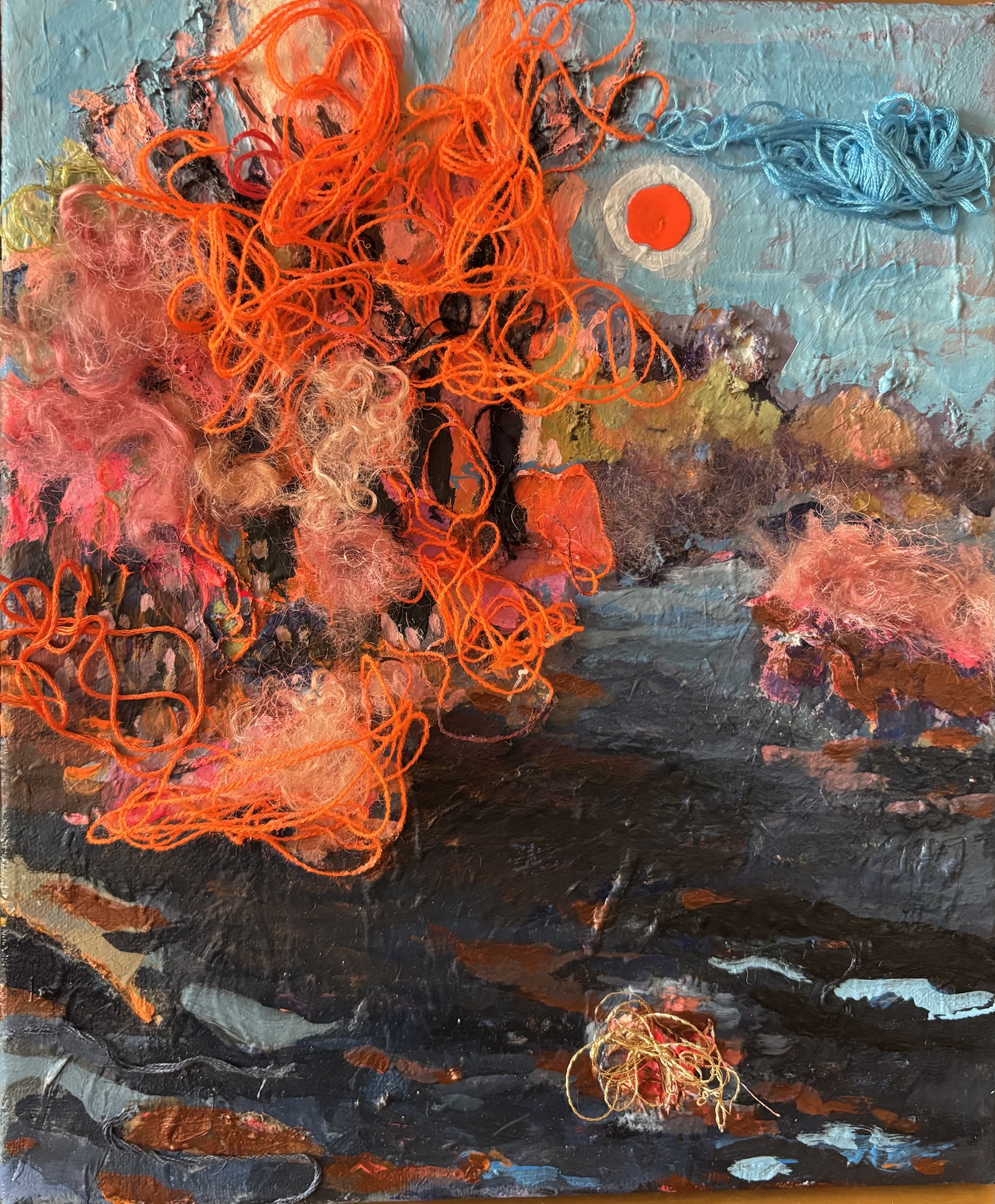
Yarn and googly eyes have something important to say

Although much of my work is an expressive interpretation of the world around me, lately I’ve been using it to describe my thoughts and emotions.

But the inner world is an untamed, nebulous landscape, and my current artistic vocabulary of impasto brushstrokes, fluid drips and bright daubs wasn’t quite cutting it.

I turned to the book “Find Your Artistic Voice,” by artist Lisa Congdon for tips on how to break free.

What resonated the most with me was her emphasis on risk-taking and experimentation. She gives permission to “make a lot of junk” as part of the artistic journey. Keep pushing, keep exploring and embrace fear.

So I reached for some craft materials. Specifically yarn, embroidery thread, tissue paper and googly eyes.

Yeah, that pretty much sounds like a kindergarten art project. Not exactly the ingredients for a serious piece of art.

But that totally works for me, for many reasons.

For one, I like the seeming contradiction of using children’s materials to share a complex message. It invites the viewer to look beyond the superficial.

At the same time, the playfulness and whimsy resonate with a core component of my personality, and feel like an honest way to share who I am.

From a functional perspective, these materials break free from the two-dimensional picture plane, creating more visual interest and expressive possibilities. It’s also helpful that yarn can be a conceptual metaphor, portraying connectedness, tension and/or flow.

The work taking shape is a mix of representational and abstract—a liminal place between mood and atmosphere. They are not exactly illustrations and yet I feel like they depict parts of me that wouldn’t otherwise be seen.

Giving myself room to experiment has resulted in art that is different from past work, while remaining authentic to who I am. Thanks to Congdon’s guidance, I’ve been able to explore expressionism with a new vitality, another step on discovering finding my artistic voice.

Self-Portrait as Birds — 8”x8” mixed media on wood panel
Self-Portrait with Googly Eyes — 12”x10” mixed media on canvas
Tethered Light — 12”x10” mixed media on canvas

Time-travelling in Newfoundland

There’s something enchanting about miniatures. It’s fun to look at familiar objects that have been shrunk to a tiny scale.

But what if a life-sized example of the object in question doesn’t exist? What is the reference point?

Kelloway Cove gallery and cafe is located in a miniature wooden store, built by my great-grandfather in the style of a Newfoundland trading post, circa 1900.

I can only imagine what it would feel like to walk through its (six-inch) door. I would love to gaze through its huge front windows at the North Atlantic, while sipping a cup of strong tea.

The real deal!

So I was pretty excited when I came across photos of a real-life building in the same style as Kelloway Cove.

I was looking at my cousin’s Kelly’s vacation photos — she had gone on a road trip around Newfoundland with her mom and step-dad. It was a pilgrimage of sorts, a tour of the landmarks and landscapes of our family history. (Side note, Kelly was named in homage to our Kelloway ancestors.)

When I saw the photo of the Bicycle Picnics Cafe, situated in the coastal village of Bonavista, I yelped with glee.

The resemblance to my vintage toy store was unmistakeable, from the flat roof and wooden clapboard siding to the high ceiling and large plate-glass windows, right down to the inset door.

A quick online search led me to the cafe’s website, where I found more photos, both interior and exterior — including images of its stunning ocean view.

According to their website, the site of their cafe was where local fishermen exchanged fish for credit notes – which was used to get food and supplies for the winter. It is now a Provincial Historic Site.

And although I have yet to visit the cafe in person, I’m satisfied in knowing that this relic of my great-grandfather’s time still exists.

Bonavista Bicycle Picnics Cafe, Newfoundland

Post script: The cafe reimagined

Funnily enough, that Bonavista cafe popped up in an episode of Severance, an Apple TV series.

Although it was set in winter, and staged with a rather bleak ambience, I recognized it immediately, as if it were a member of my family.

A piece of the past, just waiting for me to drop by.

“Severance” Season 2, Episode 8 was shot in Newfoundland and Labrador

Sketching Strangers: I’m embracing my mistakes

In 2024, I started carrying a 4”x 4” sketchbook and felt pen with me everywhere I went. My goal was to get better at drawing people.

Specifically, I wanted to become more accurate with proportions, and to be able to capture the overall feeling of a pose.

The challenge is that my subjects would be strangers, and I didn’t want them to know I was drawing them. On average, I would have between one and three minutes to do a sketch.

With these constraints, I recognized that many of my drawings would not turn out well. Even so, for the first couple months, I would catch myself being self-critical and feeling disappointed with the results.

The irony is that being so hard on myself just made me tense, which made my drawings more awkward.

Yeah, some of my drawings are bad

Finally, at one point, I just decided it was okay to “do bad drawings.” The plan was just to focus on the process (draw fast, and often) and not the results.

Two things happened. I started to enjoy the process (no stress!) and my drawings slowly improved.

This is not a concept that I invented! It’s something I’ve read about in various self-improvement books… and it works.

“Many people cite learning a new language as an essential project, a dream that matters to them. But they never practice because they are embarrassed. They want to be flawless-or at least not make fools of themselves-from the start. But a friend of mine who teaches Spanish sees it differently. He teaches his language students to imagine they have a bag full of one thousand beads. Every time they make a mistake talking to someone else in the language they take out one bead. When the bag is empty they will have achieved level 1 mastery. The faster they make those mistakes, the faster they will progress.”

Greg Mckeown, Effortless

I’m now on the last page of the sketchbook and just bought a new one for 2025!

Click here to view more of my sketches.

The big benefits of tiny art

A lot the artwork featured on this website is small — 6” x 6” or less.

I like painting small for many reasons.

One obvious benefit is that Kelloway Cove is a miniature art gallery at 1:12 scale (one inch equals one foot in real life). Its biggest wall is 23” wide and 13” high, so there are limits as to what can fit!

But I’ve actually been painting in small formats consistently since 2020, thanks to an online painting course I took during the pandemic.

“Habit-forming Flowers” is a 6-week self-led flower painting course created by artist-couple Brian and Debbie Miller. They encourage participants to work on six-inch square wood panels, something I hadn’t done before.

Painting small requires a different approach – and gives unique results.

It would be easy to drive myself crazy by trying to work with teeny brushes and using a magnifying glass to get the details right. But the key to success is to use as large a paintbrush as possible. This forces me to focus on the overall composition and values, not fuss on the details.

And by completing an entire painting in one sitting, I can learn from each piece and then hone my new skills on the next painting.

Adopting this approach allowed me to progress much more quickly than I had in the past. I learned more in those six weeks than I had the previous six years.

I also discovered several other benefits:

  • Small paintings use fewer materials, so they cost less to make.
  • They don’t take up a lot of storage space (helpful, since I don’t have an attic/garage/basement).
  • They are more affordable for potential buyers, giving more people the opportunity to buy one-of-a-kind art.

I’m not against working on a larger format – it is satisfying in its own way – but I definitely find myself gravitating towards small format so that I can just keep painting and learning.

A few paintings done during the “Habit-forming Flowers” course, 2020

Check out Brian and Debbie’s course here: https://www.theymakeartuniversity.com/habit-forming-flowers-part-1